
Real talk, if you’ve been online lately (who hasn’t), you’ve probably noticed that something feels… off. Blog posts that sound like a robot wrote them (because a robot did). Social captions sound like they could belong to any business in any industry. Emails are so generic that they make you feel like you’re being marketed to by a sentient spreadsheet.
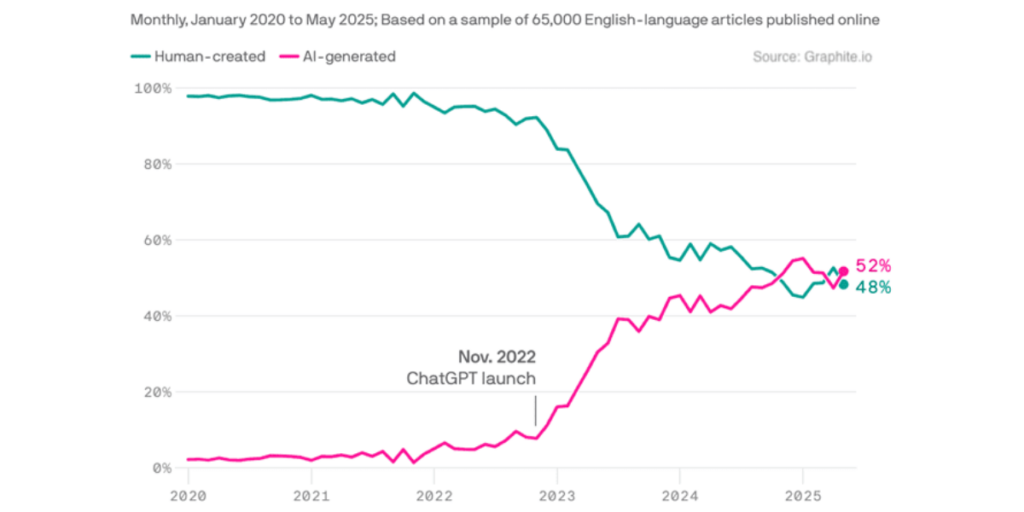
Here’s the cold, hard, slightly horrifying data: AI-generated content now makes up 52% of all English-language articles published online, officially surpassing human-created content for the first time. (Source: Graphite.io, based on a sample of 65,000 articles, January 2020–May 2025.)
The majority of content pushed out on the internet right now was written by ChatGPT (or one of ChatGPT’s many pals). It’s bland, boring, and the content equivalent of gas station sushi—sh*tty. Once you learn to spot the generic AI text, it’s hard not to see it everywhere. Just like humans, AI seems to have its favorite phrases and filler words.
But here’s why this is exciting for you…While ChatGPT is flooding the internet with cookie-cutter copy, there is an enormous white space opening up for real human voices with real opinions, real personality (!!!), and a real brand voice and tone. And that is exactly where your business needs to live.
Caro, What Is Brand Voice and Tone?
I’m so glad you asked, because this is the foundation of your marketing. Before you start drafting emails, crafting social captions, and writing up your web copy, you MUST decide who your brand is.
Think of your brand voice as your personality: it’s consistent, it’s yours, and it doesn’t change across platforms. Are you bold and direct? Warm and nurturing? Sarcastic and sharp? That’s your voice.
Your brand tone is how that personality shows up depending on the platform/situtation. Your overall brand voice might be witty and sarcastic, but your tone shifts slightly (a little warmer in a condolence email, a little more exciting in a product launch). Same voice, different platform. It’s similar to how you talk to your best friend versus your best friend’s grandmother. Still you, just adjusted.
Together, they are what make your copy sound like you instead of every other business in your industry. And in 2025, when AI can churn out a mediocre blog post in 11 seconds, having a distinctive, human, unmistakably-you brand voice is your biggest competitive advantage as a small business.
One of My Favorite Brand Voices
My love for the Liquid Death copywriting team is similar to my husband’s love for the Cleveland Browns. Loyal and borderline obsessive. They are just THAT GOOD. One of my favorite marketing campaigns they ran featured negative testimonials they received.
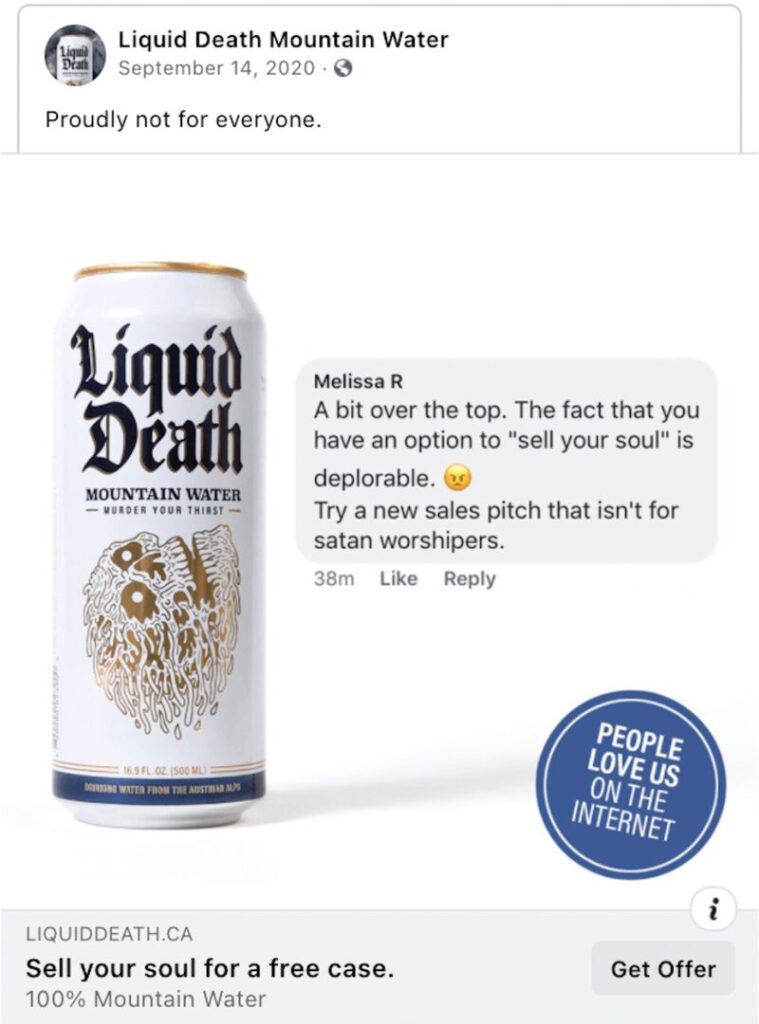
Let’s break down Liquid Death’s brand voice.
The core persona is heavy metal with an absurdist comedy twist. Liquid Death’s brand voice speaks like a death metal band that just so happens to sell canned water. Their copy is dramatic, irreverent, and over-the-top.
Personality traits
Aggressively anti-corporate. They mock the sanitized, aspirational language of wellness brands. While competitors talk about “hydration journeys” and “refreshing moments,” Liquid Death talks about “murdering your thirst” and “selling your soul.”
Self-aware and absurdist. The humor works because it’s in on the joke. They know water is mundane, so they treat it like a dangerous substance. Their tagline, “Murder Your Thirst,” is ridiculous on purpose.
Punk/anti-authority attitude. The voice pushes back against norms. Anti-plastic environmentalism gets framed not as feel-good virtue signaling but as rebellious action. Doing good is “badass,” not wholesome.
Short, punchy, visceral language. Lots of imperatives, blunt phrasing, and words with violent or extreme connotations (“destroy,” “murder,” “sell your soul”). Minimal fluff.
Liquid Death makes buying canned water feel like an identity statement. The voice attracts people who are allergic to typical marketing and rewards them for paying attention.
Your Customers Are Real People
Here’s what the “AI is taking over” doomers are missing in all of this: yes, AI has flooded the internet with a metric ton of forgettable garbage. But your customers are real humans with real feelings, problems, and a human desire to connect with other real humans.
When someone lands on your website or reads your Instagram caption, they’re not just looking for information. They are auditioning you (or your brand). They want to know: Do I like this person? Do I trust them? Do they get me?
And a chatbot cannot answer those questions. No matter how many times it’s been told to “sound conversational.”
This is why human-generated content is having a powerful renaissance. People are starving for authenticity. They can smell AI copy the same way Kris Jenner can sniff out a new brand that one of her children can successfully launch. They just know. And when they find a brand that sounds like a person who actually gives a damn? They stay. They buy. They tell their friends.
Your human voice — your opinions, your humor, your specific way of explaining things — is not a liability in the age of AI. It is your secret weapon. And it is time to use it.
Small Business Copywriting Tips
How to Define Your Brand Voice
Okay, let me break it down for you because simply saying, “be authentic!” is advice that sounds great and means absolutely nothing when you’re staring at a blank Google Doc at 10 pm, wondering what to post tomorrow.
Here are some small business copywriting tips for nailing down your brand voice and tone:
Describe your brand like a person, not a business. If your brand were a Kardashian sister, which one would it be? It sounds ridiculous, but I need you to just take a second and think about it. Let’s pick Kim for the example. Personality descriptors like softly seductive, confident, and minimal are more effective in building a brand voice rather than “warm and kind.” If you’re not a Kardashian fan, maybe think about characters from your favorite movie or book. Ex: Harry Potter and Hermione Granger have very different personalities. Your brand, similarly, should have its own distinct personality.
Identify 3–5 words that define your voice, and 3–5 that are totally off-limits. Maybe you’re sassy, sarcastic, and humorous. Some words your brand might not relate to could be corporate, stiff, or vague. Write those down, keep them close by, and use them as a filter for everything you publish.
Look at your best customer emails or DMs. How do you write when you’re just being yourself? That is your brand voice. Bottle it and scale it.
Read your copy out loud. If it doesn’t sound like something you/your brand would actually say, it doesn’t belong on your website. Simple as that.
Create a short brand voice guide. Even a one-pager with your voice descriptors, your tone guidelines, and a few “we say this / we don’t say that” examples will completely change the consistency of your content.
Human-Generated Content Will Always Win Even When AI Gets Better
I want to be real with you here, because I’m not here to just dunk on AI for the sake of it. AI is a tool. A useful one, even. But there are things it structurally cannot do, and understanding that is what gives you the edge.
AI cannot have a genuine opinion. It can simulate one, but it doesn’t actually believe anything, and readers, especially savvy buyers, can feel the difference between a real take and a performance of one.
AI cannot draw on your specific lived experience; your industry expertise, your client stories, your hard-won lessons. That context is what makes content trustworthy and compelling.
AI cannot build a relationship. Your audience is deciding whether to trust you with their money, their problems, and their time. That trust gets built through consistent, authentic human connection over time.
Take a second and think about your favorite podcaster, newsletter writer (like the Morning Brew), or business account. I’d bet my kids’ college tuition that what you love about them is their voice. The way they phrase things, their specific sense of humor ,and the opinions they’re not afraid to share. Those point of views are not AI-generated. Developing a voice like that for your brand (that makes people become a loyal follower) is exactly what working with a skilled business copywriter helps you do.
Signs You Might Need Some Copywriting Help
I’m a copywriter and your hype woman, so let me be straight-up. If any of these hit a little close to home, it’s time to get some help:
- Your website sounds like it was written by a committee of very tired accountants
- You’ve used the phrase “we are passionate about serving our clients” unironically
- Your social captions could have been written by any business in your category
- You’ve copy-pasted from ChatGPT and told yourself it was “a rough draft” (it wasn’t)
- Someone asked what makes your business different, and you froze like a Bachelor contestant being asked about their feelings.
- You feel embarrassed to send people to your website because it doesn’t sound like you.
I’m not trying to roast you, I’m simply offering a reality check. And the reminder that this is all fixable. A strong brand voice, consistently executed human-generated content, and some strategic copywriting will improve how your business shows up online.
This Is Your Main Character Moment
The internet is noisy and getting noisier. More content is being produced every day than any human being could read in a lifetime, and the vast majority of it is indistinguishable AI output designed to game algorithms rather than connect with actual people.
Now is the time to stand out as the main character in your industry with a brand and content designed for the CONSUMER, not the algorithm. I promise you, the authenticity will improve your sales and algorithm rankings organically.
Building out an authentic brand voice and committing to human-generated content is not some fluffy, optional marketing nice-to-have. In 2026, it is your most powerful differentiator. It is how you turn strangers into fans, fans into clients, and clients into loyal advocates who send you referrals without being asked.
Head over to clevelandcopywriter.com/contact and let’s schedule a discovery call. We’ll talk about where you are, where you want to be, and how to get your copy sounding like the best, most confident version of you.
Frequently Asked Questions
Can’t I just use AI to write my content and tweak it a little?
Technically? Sure. Strategically? I’d pump the brakes. The problem with the “generate and tweak” approach is that you usually end up polishing AI’s mediocre ideas instead of leading with your own. Your audience can feel the difference because there’s a flatness to AI copy that even good editing struggles to fix. More importantly, if your brand voice isn’t established first, the AI has nothing to mirror. It’ll default to generic copy. Use AI as a brainstorming tool or research assistant, but let a real human, ideally a skilled copywriter, shape the actual voice and message.
How long does it take to develop a brand voice?
Less time than you think, but more than a weekend. A focused brand voice and messaging project with a business copywriter typically takes one to three weeks, depending on the depth of the work. What you end up with is a clear, documented brand voice guide you can use across all your channels—website, social, email, all of it. It becomes the north star for every piece of content you (or anyone on your team) ever creates. It is quite literally an investment piece that pays dividends on every marketing touchpoint.
I’m a small business, is hiring a copywriter really worth it?
How much time are you currently spending trying to write copy that doesn’t feel right, and how much business are you potentially losing because your website or content isn’t converting? For most small business owners, copywriting is the thing they know matters but keep pushing to the bottom of the list. A copywriter does the heavy lifting so you can focus on what you actually do best. And unlike much marketing spend, good copy keeps working for you long after the invoice is paid.
Book a Free Discovery Call
Your brand voice is waiting. Let’s find it.
✓ Free Call
✓ 30 minutes